Sunday, April 12, 2020

Reading: Family Recipes


It was the inscription in a little handwritten recipe book my mother gave me that prompted me to think about reading recipes this morning:

To Cheryl,
A collection of some of “old” and new favourites that I’ve enjoyed making for us over the years.
   -  Love you, Mom.  Easter 2008

Be it Christmas, Easter or Thanksgiving, the recipe I always look up is the "Turkey Dressing" recipe I grew up enjoying.  I see in my book that Mom has written “Del, Ruth, Pat, 1998” here, telling me that her mother (Del), mother in-law (Ruth) and she all contributed to this recipe.

In addition to a offering good excuse to open the red wine early (it calls for a half cup), this recipe calls up warm family memories.  I am always amazed that bread crumbs (in my case, gluten-free bread and 'crumbed up' in a blender), summer savory, salt, pepper, onions, celery, mashed potatoes, butter and wine can come out of the turkey tasting so delicious!  Or maybe it’s the taste of good remembrances.  (Or maybe it's the wine.)

My Whole Foods for the Whole Family cook book by Roberta Bishop Johnson has the apple crisp recipe I am making for dessert today, while the Practical Paleo cookbook by Diane Sanfilippo has a lovely gluten-free blueberry crumble recipe.  (Two desserts - because when you cook for a household where some eat gluten free, and others emphatically do not, you end up making two versions of everything.  Today it will be dual dressings and dessert.  Last evening it was dual pizzas.  Lots of mornings it's two type of pancake.  I read a lot of recipes for that reason alone!)

I'm happy to share the blueberry crumble recipe with you, with credit going to Diane Sanfilippo:

  • 2 pints (that’s 4 cups) of fresh blueberries
  • Juice of 1 lemon
  • 1 cup almond meal/almond flour
  • ¼ cup chopped macadamia or walnuts.
  • ¼ cup melted butter or coconut oil
  • 2 T maple syruo
  • ¼ tsp cinnamon
  • 2 pinches sea salt

  • Preheat oven to 375 degrees F
  • Place blueberries in a 9 x 9 inch baking dish
  • Squeeze the juice from half the lemon over and toss slightly
  • In a bowl, combine almond flour, chopped nuts and melted butter or oil, remaining lemon juice, maple syrup, cinnamon and salt
  • Spread the nut topping evenly over the blueberries and bake until fruit is well cooked/bubbly and the topping is golden brown (about 30 – 40 minutes).

Some Easter, when I handwrite a recipe book for my kids - and I will - I will be sure to include this one.  I hope you are enjoying some recipes, traditional family or brand new, this holiday as well.


Cheryl Brown (@CherylAnneBrown) is co-creator of the Storytent and Bookwagon programs, QLNB's Community Literacy Coordinator, and long-time advocate for and facilitator of a variety of family literacy initiatives.  In these posts, she has been documenting and sharing snap-shots of some of her daily reading.

Friday, April 3, 2020

Learning at Home


This Government of New Brunswick webpage offers an important message affirming of the importance of parents to family learning, and also links to tools for families with children at home.

Learning happens in the everyday moments that you share with your children. Although many of our roles are different right now, we want to assure you that, as caring adults, we will continue to be right beside you and your child/ren, providing you with resources and encouragement.

We want to thank you and remind you that you are doing a great job.  We also want to remind you that it is okay to keep learning expectations reasonable for your child/ren and yourself!  While going through this, everything you and your child/ren do together is teaching them very important lessons about life, our province and the world around them.

We know that children are always learning, and will continue to learn, even when schools are closed.  This page provides resources and information to help your child/ren keep learning.


Thursday, March 12, 2020

Reading: Magazines


One day not long ago, I noticed these magazines all over the floor beside my bed, and I thought, “I should clean those up.”  Then I remembered I was writing about my daily reading, and I thought, “I should write about reading magazines.”  So I did that instead.

In my pile of magazines there is a December 2015 edition of National Geographic, three more recent editions of Alive magazines which I collect monthly from natural health food stores (the Corn Crib in Saint John or Aura in Fredericton), two recent editions of Eating Well, the latest Vogue Knitting magazine, the latest ECO Parent magazine, two editions of Saltscapes from last fall, and the winter 2019-2020 edition of Edit.  Missing from this list - I suppose because they are in my car or further under the bed - are Mother Earth, Sage and Knit Simple.

Actually, this is starting to sound less like daily reading, and more like an obsession.  What is it about magazines?

I’ve always enjoyed magazine reading.  I grew up on Highlights magazine and Young Miss.  I remember how exciting it was to receive a magazine in the mail.  Wanting to pass on that excitement, I made sure all my children got their own Chirp, Owl or Highlights magazine in the mail.

My reading habits changed when I had children.  Life before kids meant two or three novels a week.  Life after meant re-reading Dr. Suess and Spot the dog.  What bridged these two worlds was reading magazines.  I could finish an adult article, or at least an interesting article, in a short period of time, and feel semi-productive intellectually.  I remember reading a lot of Mothering magazines, editions of Today’s Parent and, later, the magazine Rethinking Schools.

When I was a young adult, I loved spending time with my grandmother.  I remember her telling me a story about how she and my grandfather read magazines.  They used to purchase all the magazines available to them each month, read the whole lot, and then “talk” (discuss, debate, argue, rant) about the articles.  I remember thinking how wonderful it was that my grandfather, a real man’s man, would read the ladies’ magazines.

But why wouldn't he?  Magazines are so enjoyable!  I love when they have a local flavour.  I was delighted to read about Saint John’s own Santa (Vern Garnett) in the December 2019 Saltscapes.  What a lovely article – yay Vern!  As well, this winter’s edition of Edit features Jenn Carson, physical literacy guru and library director of the L.P. Fisher Public Library in Woodstock.  Yay New Brunswick!

I also love those magazines that come cleverly disguised as journals.  They’re the same size and shape, give you good up-to-date information and allow for quick, profitable reading.  They also have a lot fewer advertisements, and sometimes you can get away with reading them at work.  (For my workplace, I get Childcare Exchange in the mail.)

Finally, I love magazines as a kind of collective memory.  Libraries bind and preserve magazines for good reason - for the same reason I am not sure I can part with my Mothering collection, or my Mother Earth mags.  I still have all my Hallowe'en magazines, including many of Martha Stewart's, and, I'm sure, every Christmas magazine I have ever purchased.  I don’t even want to try to list or count my knitting magazines!  Is this obsessive?  No, it's not.  Not really.  It's a sensible and effective way to ensure I can share an article, refresh my own memory, or reach back for a needed recipe or pattern.

Anyway, I love reading magazines.

Photo by Britta Jackson from Pexels
Cheryl Brown (@CherylAnneBrown) is co-creator of the Storytent and Bookwagon programs, QLNB's Community Literacy Coordinator, and long-time advocate for and facilitator of a variety of family literacy initiatives.  In these posts, she has been documenting and sharing snap-shots of some of her daily reading.

Saturday, February 29, 2020

Reading: The Witcher

Editor (narrator voice): Cheryl, isn't it time you wrote another 'What I'm reading' post?  Maybe about reading a storybook to a child, or an essay on family literacy, or perhaps a literary classic?

Cheryl (waves hand): Go away.  I'm busy.  I'm reading... something else.


Cheryl Brown (@CherylAnneBrown) is co-creator of the Storytent and Bookwagon programs, QLNB's Community Literacy Coordinator, and long-time advocate for and facilitator of a variety of family literacy initiatives.  In these posts, she has been documenting and sharing snap-shots of some of her daily reading.

Saturday, February 15, 2020

Reading: Knitting Patterns and Baby Yoda


Sometimes knitting patterns are for very useful things, like socks, or dishcloths, or sweaters.  Sometimes you knit something just for fun.  For the past 10 days or so, I have spent most of my free time reading a very special knitting pattern.

If you have watched The Mandalorian, you are familiar with The Child, a.k.a Baby Yoda.  If you haven't watched the series, you've most likely seen the social media memes featuring that cute little Yoda face!  I was talking to a friend whose wife loves Baby Yoda. “I bet I could find a pattern to knit her a Baby Yoda,” I said.  And sure enough, thanks to the internet, there were a few pattern options.  I chose one by Addie.
 
Now, I’ve been knitting for over 40 years, so I thought this would be easy.  But this is how the pattern started:
Head (begin by working  widest part of head up to crown). Using scrap yarn, US #3 dpns, and crochet hook, CO 80 sts with the provisional cast on method.

Whaaaa…?  With some help from YouTube, I tried this new-to-me method of casting on.  Things didn't turn out exactly like the pattern said they should, and I'm pretty sure I need more practice.  There was a lot of specific knitting vocabulary in the 8 page pattern (i-cord, gauge, knitwise), plus all sorts of knitting abbreviations (M1, Ssk, K, P, K2tog, CO, p2tog tbl).  Plus, the pattern suggested buttons for eyes, while I stuck on two animal noses.  Still, my end result was pretty adorable, and my friend scored major Valentine points with his wife.  Here's the selfie I took with the finished product.


Somebody said (I've seen it on T-shirts), "Knitting is not a hobby, it’s a post-apocalyptic life skill."  Reading knitting patterns is an example of authentic literacy.  I've moved on to reading a nice simple seed stitch hat pattern.


Cheryl Brown (@CherylAnneBrown) is co-creator of the Storytent and Bookwagon programs, QLNB's Community Literacy Coordinator, and long-time advocate for and facilitator of a variety of family literacy initiatives.  In these posts, she has been documenting and sharing snap-shots of some of her daily reading.


Sunday, February 9, 2020

Annual General Meeting

Quality Learning NB

Notice of

Annual General Meeting


Thursday March 12, 2020

Saint John Free Public Library Maker space

6:00 pm

Friday, January 31, 2020

Reading: With Little Kids


This week I was invited to Family Literacy Week activities, and asked to read to infants, toddlers and preschoolers.  Yay!  Little kids are my most favourite reason to read.  I read
Goodnight Moon by Margaret Wise Brown
Sing a Song of Mother Goose by Barbara Reid
I am a Frog by Mo Willems
The Very Hungry Caterpillar by Eric Carle
Pete the Cat and his Four Groovy Buttons by Eric Litwin
This is not my Hat by Jon Klassen
T is for Terrible by Peter McCarty.
You can see in the photo that the little ones are interested in playing with the little story basket I made.  Ann from Little Worlds tells us story baskets are "baskets with random objects from the play room, daily life or nature which prompt children (or adults) to tell a story using those objects."  Jode from The Empowered Educator adds that they "also introduce a wonderful tactile experience to storytelling and this can help educators and parents introduce and engage visually impaired children as well ...[providing] a hands on learning opportunity for all children no matter their age group or developmental stage."

I put in items from Goodnight Moon (comb, brush, bowl, three little bears, mittens...  but no mush) in a wide basket.  Making this type of story basket with book available and accessible is a wonderful opportunity for little ones to experience a story physically, and to later go back and re-tell it in their own way and own time as often as they like.

I had a cow and dinosaur puppet helping me tell some of the stories (which elicited a wild response - the Dino was tickled to death, completely failing to convince the children he was "terrible").  I gathered some musical instruments from the room to help with the Sing a Song of Mother Goose book.

The children loved the subtraction in the tale of Pete’s wayward buttons, and they were very quick to infer possible fates for the little fish in Klassen’s book "He’s in the big fish's belly!" "No! he’s still hiding in the leaves!" "He’s behind the rock!" Very, very cool.


Cheryl Brown (@CherylAnneBrown) is co-creator of the Storytent and Bookwagon programs, QLNB's Community Literacy Coordinator, and long-time advocate for and facilitator of a variety of family literacy initiatives.  In these posts, she has been documenting and sharing snap-shots of some of her daily reading.

Sunday, January 26, 2020

Reading: Family Books

“Behind every great movie is a great story”

I think Walt Disney said that in a black and white preamble to Bambi or some other movie I watched as a child (and again as a parent).  It is often true. So when the latest rendition of Little Women in movie form was released this holiday season, I was anxious to see it, but not before reading the book again.  It has been about 40 or so years since I first read it, after all.
   
I found it after the Christmas tree came down - it was on the bookshelf behind the tree - and put it on my to-read pile.  I just finished it this weekend.

I fondly remembered the illustrations.  It was a familiar story and yet different read through my adult lenses.  I probably didn’t notice the impacts of the poverty of wartime or the preposterousness of the patriarchal structures of the time on my first read.  I cried a couple of times: once when Beth died (Spoiler Alert!) and then again at the end when Jo found love and contentment after a restless period.  Of the four women, Jo, the book loving 'tomboy' sister, was my favourite.

I own a 1955 printing of the Louissa May Alcott classic that once belonged - and maybe still belongs - to my mother; I see that she wrote her name and address on the inside cover.


She wrote her name again on the back cover, adding the date XMAS 1956.  (She would have been 10 years of age).

Daughters read their mother’s books.  Last year, my adult daughter told me she got hooked on Harry Potter because one day, having read all the books on her own bookshelves, she came searching through mine.  She found The Chamber of Secrets by J.K. Rowling, the second book in the Harry Potter series.  She read it and loved it, and realized there was a first book, The Philosopher’s Stone, that she also found my bookshelf.  Since then, I have purchased and read each new Harry Potter book, only to watch it end up on her shelf.  In fact, it was only this past fall I finally got a full set that stays on my shelf.

Last evening, I asked my mother if she gave me the Little Women book, or if I absconded it.  She couldn’t remember and said either was likely.  Maybe in the end it doesn’t matter.  What matters is that we parents have bookshelves full of great books that are available and accessible to our children.  That is how children ‘borrowing’ these books becomes a wonderful family literacy tradition.

Happy Family Literacy Day!


Cheryl Brown (@CherylAnneBrown) is co-creator of the Storytent and Bookwagon programs, QLNB's Community Literacy Coordinator, and long-time advocate for and facilitator of a variety of family literacy initiatives.


Tuesday, January 14, 2020

Reading: About Reading Magic

The fire of literacy is created by the emotional sparks between a child, a book and the adult reading.  It isn’t achieved by the book alone, nor by the child alone, nor by the adult who’s reading aloud – it’s the relationship winding between all three, bringing them together in easy harmony. (Fox, 2001, p. 10)

This is a quote I found in the Province of New Brunswick's Exploring Literacies Handbook (2018), and I love it.  When I looked up the reference, I found it was from Mem Fox's book Reading Magic: Why Reading Aloud to Our Children will Change their Lives Forever - next up on Cheryl’s reading-for-fun list.

Reading about reading for fun?  Why not?  I love reading about reading, and I’ve done a lot of it.  Jim Trelease’s Read Aloud Handbook, Paul Kropp’s How to Make Your Child a Reader for Life and more recently Denny Taylor's Learning to Read and the Spin Doctors of Science are just a few of my favourite reads about reading.  But I had not yet read Mem’s book, and there it was on my shelf.

Mem’s writing for grown-ups is both witty and blunt.  She’s also an author of children’s books - I love Tough Boris - and herself a mom.  She tells us she brings all three to her work on literacy in words that really resonated with me: “I speak with the authority of an international literacy consultant and the intensity of a writer, but I am most passionate when I speak as an ordinary mother.  I hadn’t realized that reading aloud regularly would mean [my daughter] would learn to read without being taught" (p. 4).

I loved being a significant part of my children becoming readers, and I read aloud to them before bedtime for as long as they would let me, enjoying what Mem calls (p.20) the "private language that develops in families through shared book experience."  I will never forget making and wearing family T-Shirts that said "Hobey-Ho!," something the young protagonist of Pendragon would say prior to another adventure.  (Pendragon by D.J. MacHale is a 10 book YA series I've read aloud twice.)  Reading aloud to my own children gifted me the pleasure of that time spent with them, as well as allowing me to experience and re-experience wonderful children’s literature.

Mem also co-verified the relationship and literacy development that happens as well as when we read and talk about everyday things with our children.  Anyone remember reading the Sear’s Wish Book (Christmas catalogue) as or with a child?  Referencing Dr. Sue Hill of the University of South Australia, Mem reminds us (p.19) that things like food or product packaging, postcards and flyers, signs and instructional guides all offer chances for engaging, authentic reading for and with our children in our daily worlds.  "We don’t need drills and skills, or horrible workbooks, or expensive programs," she later writes (p.52).  "We should not suddenly become teachers of our children.  We must be ourselves.  Entertainment is the teacher. Subtlety is the key."

For me, oddly enough, reading about reading is also authentic reading - something I do out of genuine interest and desire, and yet also for my own enjoyment.  Thanks, Mem, for another fun read on reading.


Cheryl Brown is co-creator of the Storytent and Bookwagon programs, QLNB's Community Literacy Coordinator, and long-time advocate for and facilitator of a variety of family literacy initiatives.

Tuesday, January 7, 2020

Reading: New Year's Day


I love New Year’s Day!  No presents to wrap, rooms to clean or food to cook…  just me and a book.

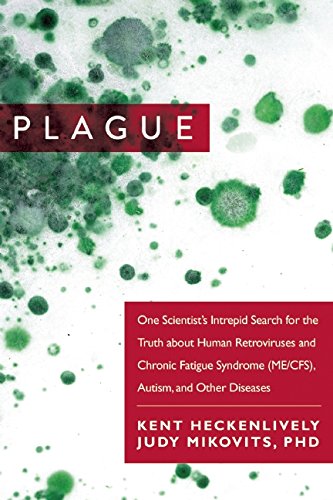
I usually pick a fiction book for my New Year’s Day read, but this time I was curious about a new-to-me book called called Plague: One Scientist’s Intrepid Search for the Truth about Human Retroviruses and Chronic Fatigue Syndrome (ME/CFS), Autism and Other Diseases (2014) by Kent Heckenlively and Judy Mikovits.

The book chronicles Mikovits’ work over a 5 year period where she investigates the second retrovirus of her career, XMRV.  (The first was HIV.)  Her amazing journey starts with the creation of the Whittemore-Peterson Institute for Neuro-Immune Disease at the University of Nevada.  This part of her journey ends with her as a witness for the federal government against her former employer, Harvey Whittemore, for illegal campaign contributions. Along the way she encountered the prejudices surrounding Chronic Fatigue Syndrome (CFS), wandered into the minefield that is autism research, and struggled to maintain her faith in the profession to which she had dedicated her life.  She also published research regarding the retrovirus XMRV that linked it to CFS, prostate cancer, lymphoma, and eventually neurodevelopmental disorders in children.

Whom better than a research scientist to write about the state of the scientific research at present?  A second book to be released in March 2020 is titled Plague of Corruption: Restoring faith in the promise of science; one I will definitely pre-order and devour.  The next time I hear that "science" backs a claim, I will certainly think about Dr. Mikovits’ ongoing experiences, and adjust my enthusiasm accordingly.  I was already skeptical of "bias free research."  Reading the story of her personal experience opened my eyes to new ways multiple players can and do manipulate and influence what the public gets to hear and know about health science and research.


Cheryl Brown is co-creator of the Storytent and Bookwagon programs, QLNB's Community Literacy Coordinator, and long-time advocate for and facilitator of a variety of family literacy initiatives.

Friday, January 3, 2020

Reading: New Year's Eve


Texts shape us by reflecting the politics and values of our society.
     - Mem Fox


Happy 2020!  It’s a new year, and I have decided to document and share books I read, no matter the reason.

On the eve of 2020, I was out with some friends for a New Year’s Eve supper.  While talking about her grand-kids, one friend asked if I knew the book Paper Bag Princess by Robert Munsch.  She said she loved the strong female character portrayal, and she had just purchased a copy for her granddaughters.

 "Elizabeth" I said, in my best storytent voice, "was a beeuuuutiful princess…!”  Yes, I know this story.  I love this story.  I could quote whole passages, and I dressed up as the paperbag princess one Hallowe'en not long ago.

Listening to her talk about Munsch's book, I thought I heard her saying she wanted to provide her granddaughters stories with strong female characters.  I know this is an important idea for her:  She is a strong  female herself and so are her two daughters.

Later that evening, at home helping my 25-year old daughter pack (she's getting ready to move), I noted some of the picture books she'd chosen to keep on her bookshelf: The Balloon Tree by Phoebe Gilman; The Paint Box by Maxine Trottier; and The Seventh Door by Michael Leach.  I sat down and re-read them to myself.  Here were more popular children's books with strong female characters.

Then I excitedly looked to my own picture book shelf to see what other titles my daughter and I might have read and held on to.  I found - and immediately re-read - The Adventures of Isabel by Ogden Nash, Maxine’s Tree by Diane Carmel Legere, and Mirette on the High Wire by Emily Arnold McCully.

I started to make a mental list of these books, thinking I would share the titles with my friend.  Then I went looking for pre-made lists online.

According to Goodreads, there are over 250 books with "strong, independent, resourceful female characters [f]or readers who are tired of reading about females only as family caretakers and/or as princesses who are rescued by a prince."  A site called  Amightygirl.com lists the "Top 100 Mighty Girl Books."  A site called Notimeforflashcards.com offers "Picture Books About Strong Girls."

Well, I couldn't read all these books before bedtime, but I was pleased to see The Paperbag Princess is on all three lists.  Go Elizabeth!  And that was how I read in the New Year.


Cheryl Brown is co-creator of the Storytent and Bookwagon programs, QLNB's Community Literacy Coordinator, and long-time advocate for and facilitator of a variety of family literacy initiatives.